
Introduction
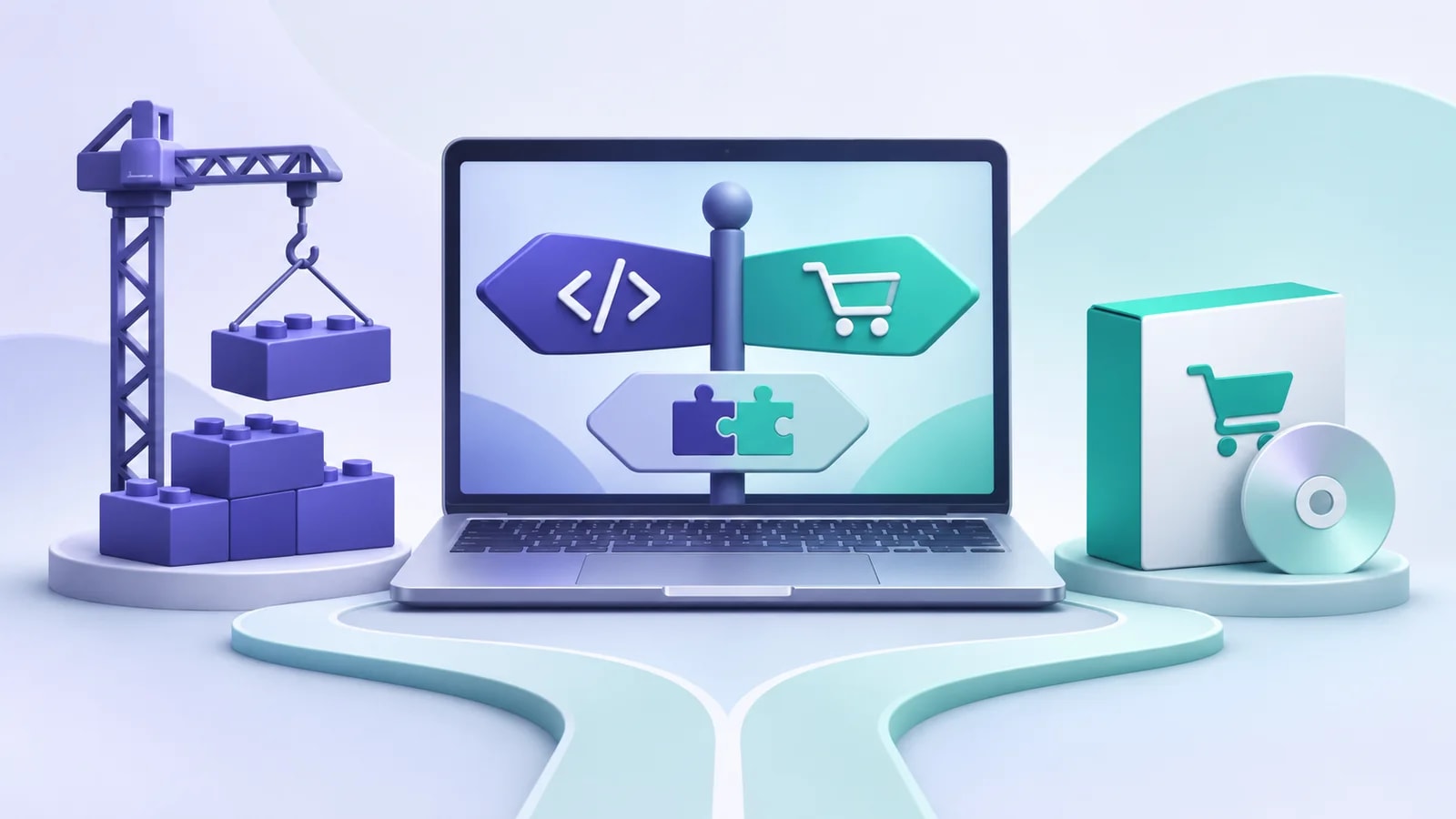
Buy off-the-shelf software when your process is like most other businesses' and a popular tool already does it well. Build custom software (in the UK it's usually called bespoke software) when the process is what makes your business different, when you're paying for several tools to do one job badly, or when no existing product fits without painful workarounds. Most businesses end up with a mix: standard tools for standard jobs, and a custom layer where they're unusual.
Below you'll find a 3-year cost worksheet you can fill in with your own numbers, and a scored decision matrix that turns the choice into a total.
What off-the-shelf software does well
Ready-made products such as accounting software, CRMs, project management tools and e-commerce platforms have big advantages:
- You can start today. Sign up, configure, import your data.
- Someone else maintains it: updates, security, hosting, new features.
- They've solved common problems for thousands of customers, including edge cases you haven't thought of.
- Costs are predictable, usually a monthly fee per user or per plan.
For accounting, email, payroll and standard sales pipelines, building your own is almost never sensible.
Where off-the-shelf starts to hurt
- Workarounds become the process. Staff export to spreadsheets, re-enter data in two systems, and keep "the real numbers" somewhere else.
- Subscriptions stack up. Five tools, each doing part of the job, each charging per user, none talking to the others.
- The tool shapes the business. You change how you work to fit the software, even when your way was better.
- Your data lives in someone else's format, and getting it out is awkward.
- Prices and features change on the vendor's schedule, not yours.
When custom software makes sense
Building your own is worth considering when at least one of these is true:
- The process is your advantage. How you quote, schedule, match buyers to sellers or deliver a service is what customers pay you for.
- Nothing on the market fits without major compromises, and you've genuinely looked.
- Per-user subscription costs across a growing team have become a significant line in the budget.
- You need several systems connected in a way none of them supports on its own.
- The software is the product, as with a marketplace or a SaaS business.
Example: what MariBiz.ai used ready-made and what was built
MariBiz.ai is a B2B marine procurement marketplace where shipowners send requests for quotes and compare responses from verified vendors at specific ports. The software is the product, so a generic marketplace tool wasn't going to fit. Even so, it wasn't built from nothing. The split looked like this:
- Used off the shelf: standard, widely used building blocks: React and TypeScript for the interface, Node.js and a REST API on the server, a PostgreSQL database, WebSockets for live updates, Tailwind CSS and cloud infrastructure for hosting.
- Built for the business: the parts that make maritime procurement work. An RFQ engine for posting requests and collecting structured quotes, multi-step vendor verification with a verified badge, vendor profiles across 121 maritime service categories, port-based supplier discovery, in-platform messaging, a side-by-side quote comparison dashboard, a shipowner and operator dashboard, and procurement analytics.
That's the pattern worth copying: buy or reuse everything generic, and spend the build budget only on the workflow customers come for.
The real costs of each choice
| Off-the-shelf | Custom | |
|---|---|---|
| Upfront | Low: setup, configuration, data import | Higher: design and development |
| Ongoing | Subscriptions, usually per user, rising with headcount | Hosting and maintenance; changes are development time |
| Fit | Good for standard processes; workarounds for the rest | Built around how you work |
| Time to start | Days | Weeks to months |
| Control | Vendor decides features, pricing and data format | You own the code and data |
| Risk | Vendor changes or shuts down the product | Project overruns; depends on a good development partner |
Compare the total over three to five years, not just the first invoice. A cheap subscription for five users can become an expensive one for fifty. The worksheet below shows how.
3-year total cost worksheet
The fair comparison is the total over three years (or five, if you expect to keep the system that long), not the first invoice. Put both options through the same formula:
- Off-the-shelf total = licence price per seat × seats × years + integration and connector costs + workaround cost (staff hours spent on double entry, exports and fixes × hourly cost × years)
- Custom total = build cost + hosting × years + maintenance and changes × years
Worked example (hypothetical inputs)
Every number below is made up for illustration. They aren't market rates and they aren't our prices. Replace them with your own quotes and figures.
| Line | Off-the-shelf | Custom |
|---|---|---|
| Licences | $45 per seat per month × 20 seats × 36 months = $32,400 | None |
| Integrations | $3,000 setup + $100 a month connector × 36 = $6,600 | Included in the build |
| Workarounds | 6 staff hours a week × $25 × 156 weeks = $23,400 | Assumed close to zero for the process it covers |
| Build | None | $40,000 |
| Hosting | Included in the licence | $150 a month × 36 = $5,400 |
| Maintenance and changes | Included in the licence | $6,000 a year × 3 = $18,000 |
| 3-year total | $62,400 | $63,400 |
With 20 seats the two come out almost level, so fit and control should decide. Now change one input: if the team grows to 40 seats, licences alone become $64,800 and the off-the-shelf total rises to $94,800, while the custom total barely moves. The opposite also happens. With 5 seats and few workarounds, off-the-shelf wins easily, and building would be hard to justify.
Two lines are easy to underestimate. Workaround time is rarely measured, so ask staff to log it for two weeks. Maintenance on custom software is a real yearly cost, so get it quoted along with the build. For realistic build figures, see our guide to what a SaaS MVP costs, or ask for a quote on your own scope.
Free quote · reply within 24 hours
Need software built around how you work?
Describe the process you want off spreadsheets. You get one fixed price in writing within 24 hours.
Bespoke or off-the-shelf? A scored decision matrix
Score each criterion from 1 to 3 and add up the total. A 1 points towards buying, and a 3 points towards building.
| Criterion | 1 point | 2 points | 3 points |
|---|---|---|---|
| How unusual is the process? | Same as most businesses | Some quirks | It's why customers choose you |
| Fit of the best existing tool | Fits with settings only | Fits with a few workarounds | Doesn't fit without major compromise |
| Weekly time lost to workarounds | Under 2 hours | 2–10 hours | Over 10 hours |
| Seat growth over 3 years | Flat | Up to double | More than double |
| Systems that must share data | One or two, with ready connectors | Three or four | Many, with no connector between them |
| Need to own code and data | Not important | Nice to have | Essential (for example, the software is the product) |
| How soon you need it | This month | This quarter | Can phase it over months |
| Who will maintain it | Nobody lined up | A partner, not yet agreed | An agreed team or partner |
- 8–12: buy off the shelf and configure it well.
- 13–18: hybrid. Keep standard tools and build only the unusual part or the integration between them.
- 19–24: custom software is likely worth scoping. Run the cost worksheet above to check.
If you land in the hybrid or build range, our software development services and the wider software and AI services pages explain how we scope and build in stages. You can also request a quote with your matrix score and worksheet numbers, and we'll tell you honestly if buying is the better answer.
The hybrid approach most businesses should consider
It isn't all or nothing. Common patterns that work well:
- Keep the standard tools and connect them. A small custom integration that moves data between your CRM, accounting software and website removes double entry without replacing anything.
- Build a custom front end on a standard back end. A customer portal built for your clients, with the standard tools doing the work behind it.
- Build only the unusual part. Custom quoting or scheduling, with everything else left in tools you already pay for.
Questions to ask before deciding
- Which part of our process do customers value most, and does any existing tool support it properly?
- How many hours a week do staff spend on workarounds and re-entering data?
- What will our subscription costs be with twice the team?
- Who will maintain custom software after it's built, and how will changes be paid for?
- Could we start with a small custom piece and expand later?
Frequently asked questions
Is bespoke software the same as custom software?
Yes. "Bespoke software" is the usual UK term and "custom software" the usual US term. Both mean software built for one business's needs, as opposed to an off-the-shelf product sold to many customers.
Is custom software only for large companies?
No. Small businesses with an unusual process often benefit the most, especially when the alternative is a tangle of spreadsheets. See signs you've outgrown spreadsheets.
Who owns custom software?
You should. Make sure the contract states that you own the code and data, and that both are stored in accounts in your company's name.
Can custom software be built in stages?
Yes, and it usually should be. Start with the smallest version that removes the biggest pain, use it, then decide what to add.
How do I compare the cost of bespoke and off-the-shelf software?
Add up three years of each: licences, integrations and workaround time for off-the-shelf, against build, hosting and maintenance for custom. Use your own quotes, not averages. The worksheet above shows the formula.
Conclusion
Most of our clients end up with a mix: ready-made tools for accounting and email, and something custom only where their process is different. That's usually the cheapest answer too.
If you're weighing it up, our software team will tell you honestly when not to build.
Free quote · reply within 24 hours
Want a fixed price for your project?
Describe the process you want off spreadsheets. You get one fixed price in writing within 24 hours.
Keep reading on Custom Software
- Does your business need a mobile app, or will a website do?Do you need a mobile app or will a website do? How to decide by how often customers return, what the phone must do, and what each option costs to run.
- How much does it cost to build a SaaS MVP in 2026?What does a SaaS MVP cost to build in 2026? The factors that drive cost and time, what an MVP should leave out, and how to keep the first version small.
- Hiring a Web Development Team in India from CanadaHiring web developers in India from Canada: the time difference by province, PIPEDA rules for customer data, written copyright transfer and how to invoice.